
November 6, 2026
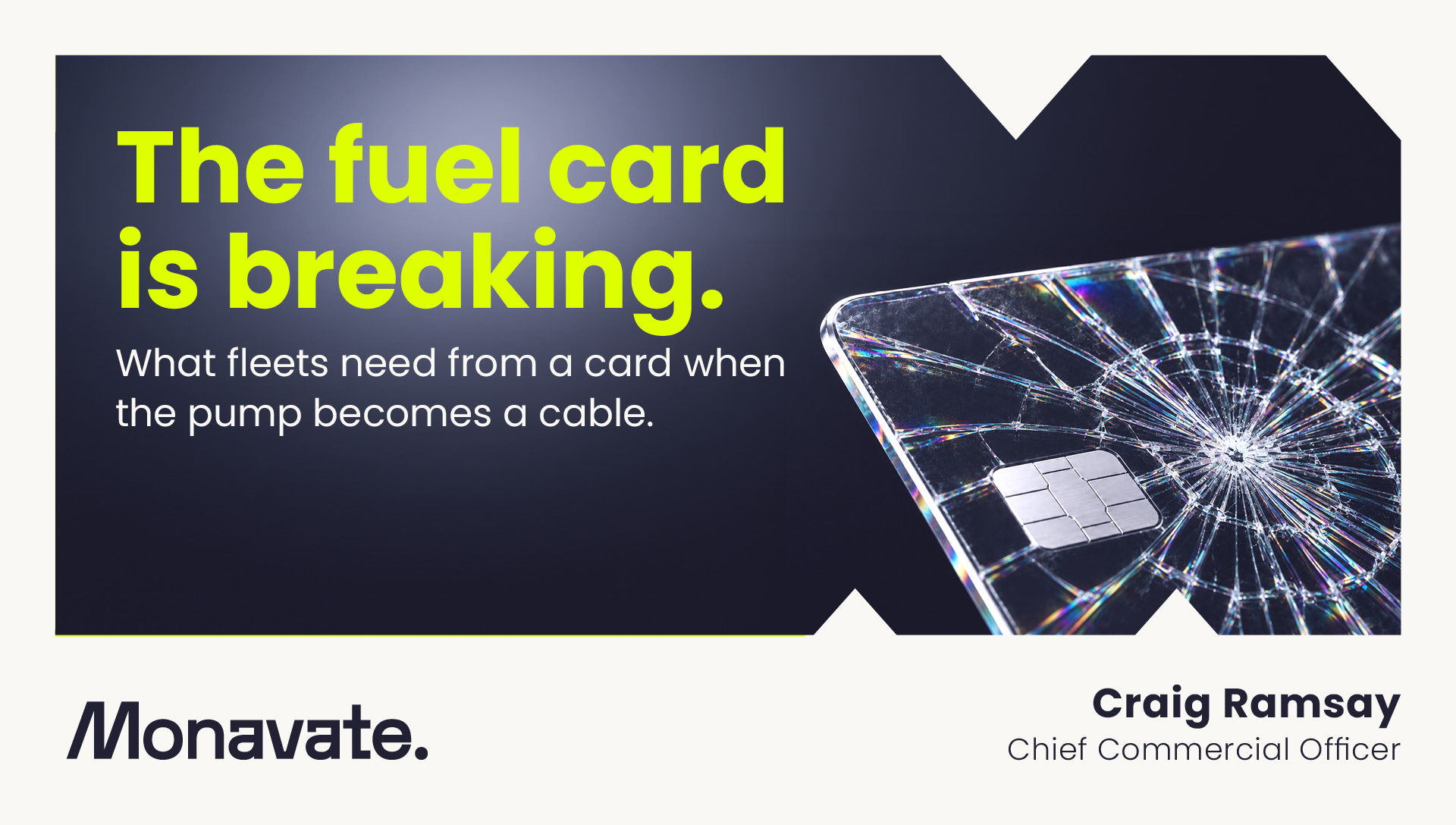
The fuel card is breaking
I have been in payments long enough to remember when the fuel card was the least exciting card in the business. For decades it had a simple job. Vans stopped at pumps, the pumps sat inside a network the card provider knew, and the card worked there and nowhere else. The corporate got a discount and Finance got a tidy statement at the end of the month. Everyone was happy enough.
That arrangement assumed the vehicle would always come back to a pump in the network.
Van manufacturers selling in the UK have a target this year of 24 per cent zero emission [1]. The market is well behind it: electric vans were 10.8 per cent of new registrations in the first nine months [2], and the government is consulting on the path to 2030. The direction has not changed. Every one of those electric vans leaves the fuel card's network the first time it plugs in at a public charger.
I’ve had a lot of discussions with fleet operators this year, and I’ve noticed the conversation move. It used to start with the price per litre. Now it starts with a driver at a motorway charger, holding a card the charger will not take, and whether a fleet operator can cover both.
Three things break at the same time: where the card works, who the rules belong to, and how the money settles.
The closed loop ends at the cable
A fuel card was built as a closed loop: an approved list of sites, and a card that worked only inside it. The list was the control. A public charge point is not on the list.
The charger itself is ready for a card. Since November 2024, new public chargers of 8kW and above, and every public charger of 50kW and above, have had to accept contactless payments [3]. The question is whether the card in the cab is one the charger will take, and whether the controls travel with it.
When they do not, drivers fill the gap with whatever works. A charging app on a personal phone. A personal card and an expense claim on Friday. Each one is a hole in the controls the business was paying the fuel card to provide.
"A fuel card that cannot pay for a charge is a card your drivers stop carrying."
Controls belong to the vehicle
Fuel card rules were written around drivers: who can buy fuel, how much and how often. That made sense when every vehicle burned the same thing and the size of the tank set the limit.
An electric fleet is managed vehicle by vehicle. A van that charges at the depot overnight and a lorry on a long route should not carry the same rules. What a vehicle can buy, where, how much and when belong to the vehicle. Drivers change shifts. The rules stay where they are.
The units change too. A limit written in litres means nothing at a charger. The control has to understand kilowatt hours and the price at that site, and it has to decide at authorisation, before the session starts, not in a report at the end of the month.
Three currencies on one run
A run from Kent to Basel leaves in sterling, crosses France in euros and finishes in Swiss francs. The driver needs the card to work at every stop.
The finance team needs one statement, in the currency of the books, with every line tied to a vehicle and a cost centre. Foreign exchange applied at a rate nobody chose, on a statement nobody can match to a route, is how fleet costs drift without anyone noticing.
The renewal is the time to ask
If your fleet card contract comes up in the next year, these are the questions I would put to any provider, us included.
- Can your card operate on both closed- and open-loop networks?
- Will the card work wherever the vehicle stops: a pump, a depot or a public charger?
- Can controls be set per vehicle, in kilowatt hours as well as litres, and enforced at authorisation?
- Which currency does it settle in, and on whose timetable?
- Does every transaction arrive with the vehicle, the site and the cost centre attached, or does somebody reconcile it by hand?
- Can the card be used beyond the fleet, for hotels, food and repairs with relevant controls?
Fleet cards are an issuing problem
These are issuing questions, and they are the work we do every day for B2B programmes. Monavate is a single regulated platform for card issuing, processing, accounts and settlement, and a principal member of the card schemes. For a fleet, that means one programme with controls set per vehicle or per driver and enforced at authorisation, settlement in the currency of the books, and transaction data that arrives already matched. Compliance is built into the programme across Monavate's regulated jurisdictions.
The fuel card was a narrow version of that idea. An electric fleet needs the full one. None of this is cause for panic. It is cause for better questions at renewal.
If your fleet is moving to electric, talk to the team before the renewal comes round. monavate.com/fleet







Founded in 2020 and now part of Exodus Movement, Inc. (NYSE American: EXOD). Monavate is a limited company registered in England and Wales with Registration Number 12472532 and registered offices at The Officers' Mess Business Centre, Royston Road, Duxford, Cambridge, England, CB22 4QH. Monavate is authorised and regulated by the Financial Conduct Authority with Firm Reference Number 901097, and Registered VAT number 439 773 155.
UAB Monavate is a company incorporated in Lithuania under Legal Entity Code: 305628001 with registered offices at Konstitucijos av. 21A, Vilnius, LT-08130, Lithuania. UAB Monavate is authorised and regulated by the Bank of Lithuania under Authorisation Code: LB002139
The money held in your Card Account is not protected by the Financial Services Compensation Scheme (FSCS). This means that, unlike a bank account, your funds are not covered by a statutory compensation scheme if Monavate were to fail. Instead, we protect your funds in accordance with the Electronic Money Regulations 2011. These regulations require us to safeguard customer funds by:
i. keeping them separate from Monavate’s own money; and
ii. holding them in designated safeguarding accounts with authorised credit institutions, or otherwise protecting them in a manner permitted by law.
Safeguarding is designed to ensure that your funds are protected and prioritised if Monavate were to become insolvent. In such circumstances, safeguarded funds should not be available to Monavate’s creditors and are intended to be returned to customers, subject to the insolvency process.While safeguarding is not the same as FSCS protection, it is a regulatory mechanism specifically designed for electronic money accounts to help keep customer funds safe.